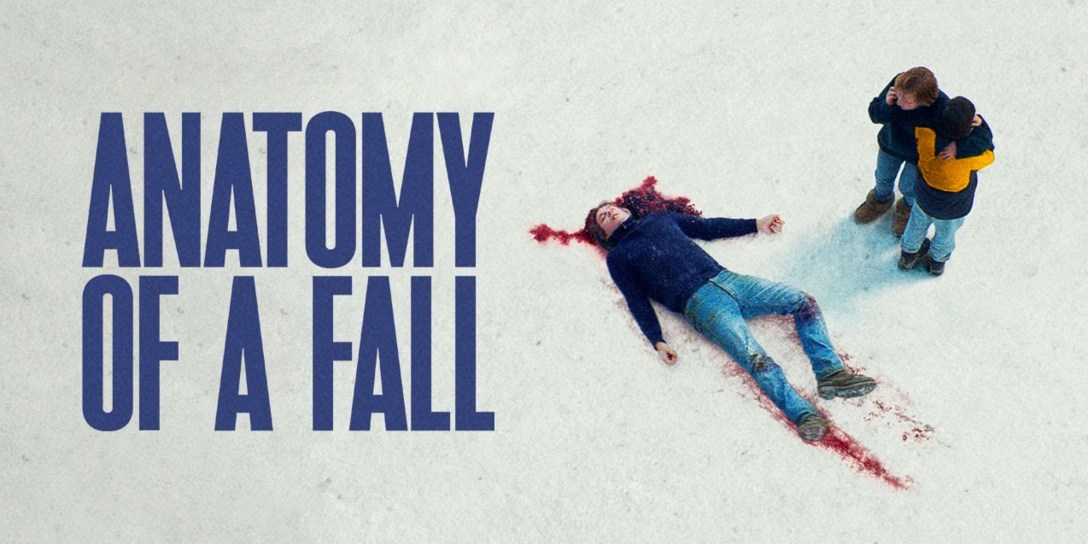
With Alpine solitude, a flirtatious magazine interview interrupted by rock music, and fresh blood staining the snow, Anatomy of a Fall (French: Anatomie d’une chute) has a suspenseful beginning. Too much has been concealed, and it seems to be the ending of a long story. A writer possibly killed her husband (also a writer), while their visually impaired son – the only witness, albeit imperfect – was not at home. The camera rolls away from the remote house, revealing the victim’s corpse, next to a mother hugging her child and phoning for help. Starting like a psychological thriller, the film initiates a cerebral search for clues. Does the child know anything, besides not being able to see?
The story centres around the mother Sandra Voyter (Sandra Hüller), a German writer who migrated with her French husband. Radiating some calm resolution not commonly found among grieving widows, Sandra excels in suppressing her disbelief, unsettledness and physical exhaustion. Did she end the interview prematurely and kill her husband on a whim? Is she going to be arrested? What will happen to the child?
Setting its audience to wonder at first, Anatomy of a Fall nevertheless defies expectations and evolves to be a somewhat rigid legal procedure and a courtroom drama scrutinising details of a failed marriage. The autopsy reveals that Samuel died from a lethal hit on the head, casting suspicion on Sandra. Sandra hires her old friend, Vincent Renzi (Swann Arlaud) to be her lawyer. The duo decide to argue that the husband, Samuel Maleski (Samuel Theis), died of suicide. It is revealed that the boy partially lost his eyesight in an accident, and the couple have been blaming each other. Sandra is bisexual and had brief episodes of infidelity with another woman. Samuel was chronically depressed, once taking bottles of aspirin in an attempt at suicide. Sandra receives grilling questions and humiliating testimonies from the prosecutor and Samuel’s psychiatrist. Guilt, depression, infidelity, plagiarism and violence plagued her marriage. Just when the courtroom seems to enter a deadlock, her son Daniel Maleski (Milo Machado-Graner), testifies that his father had suicidal attempts in the year prior to his death. Sandra is soon acquitted. Seeing his mother finally come home, Daniel reveals that he is afraid of her. Sandra is innocent, but is she?
“With no witnesses or confessions, one must interpret”, towards the final third portion of the film, one returns to the courtroom and gets reminded that one has been speculating, hypothesising and interpreting an immensely private matter. Anatomy of a Fall (now seems more like Anatomy of a Marriage) juxtaposes the private and the public, the personal and the institutional, the moral and the legal. What matters is no longer who killed Samuel, but how a state apparatus violently disseminates an imperfect private union, and how one’s personal poignancy gets publicised, exhibited, and cross-referenced. One gets reminded how a call for justice and retribution can be equally brutal and unforgiving. The husband’s sudden death and the legal procedure force Sarah and Daniel to expose their wounds and bear verbal and psychological punishment permitted by the institution. The audience wonder to what extent one is entitled to witness such private struggles, or to what extent such struggles will make sense to others. Does the death of Samuel warrant such public humiliation?
Guilt, meanwhile, is a powerful emotion in the family, noticeably present and absent. The couple could not accept that their son lost his vision. They lost their inspiration at work and passion towards each other. They were jealous, not just towards each other’s talent at work but also sex appeal in the eyes of others. They quarrelled and fought for power, accusing each other of shifting the blame. Violence soon ensued, but it was unclear, from an audio recording, who first hit the other.
After the death of Samuel, amid interviews and meetings with Vincent and the court, guilt is noticeably absent in Sandra. Hüller’s matter-of-fact performance keeps the audience uneasy but hooked – is Sandra a vicious murderer, a mother in guilt, a wife in grief or a widower dwelling in her newfound freedom? All of above? Sandra speaks both English and French in the film, but she does not speak German, her mother tongue, at home with Daniel and in the court despite available translators. If one’s mother tongue used to be the tone of innocence, Sandra acquires not just two more languages, but also new layers of disguise, new ways to bury guilt and evade responsibility. There is also Daniel, a bright boy who must have known something. Does Daniel harbour the guilt towards his parents’ failed marriage? The sensitive, reticent character provides an intricate case study for developmental psychology. The ending brings temporary relief – the boy does not lose his mother.
Ultimately, the film stands out as a testament, or an antithesis to cinematic truth. Cinema is not truth; it is interpretation. Truth, lies and manipulations occur at multiple levels in the film. Whose truth are we witnessing? Whose theory do we believe? How far do we want to know? Layers of storytelling reveal a slowly crumbling marriage and what the couple thought they had done to each other. There are more layers the film does not reveal; the courtroom drama has to end with a definite decision. The decision is what the audience wait for, not the truth. Samuel’s perspective will forever be silenced; only his psychiatrist is entrusted to speak his truth. Sandra’s emotionally distant portrayal fends off compassion from the audience, as if the emotion is forbidden. One should not feel compassion towards this widowed mother. Compassion is not necessary this time. Perhaps it is not even welcomed.
Tension is prevalent throughout the film, sometimes maybe too much of it. There was tension in Sandra and Samuel’s private union. There has been tension in the child’s buried sentimentality, fear and resentment towards some truth he’s not ready to witness. There is, of course, tension in the court; a man just died, and the state needs to know why. There was tension in the psychiatrist’s room, in meetings with legal advisors, interviews by the police, and in every audience’s incessant mental questioning. Everybody wants to know what, how and why the tragedy happened, but truth is such a treacherous word after all. Sometimes, it is the filmmaker’s job to release that tension, to harmonise with the audience’s expectation, and to reveal a tricky truth that all cinematic details have been hinting. But this is not the case with Anatomy of a Fall. Maybe we are not entitled to peace. Perhaps the tension should be left there for the audience to bear. Probably one should not pry into such a private matter. The institution is disciplining the individual, but the individual is also punishing the institution and its complicit, in this case us. In that sense, the film somehow resembles great Greek tragedies, drawing inspiration from their fixation on familial grievances, institutional brutality, the curse of personal choice and freedom, as well as moral dilemmas.
The central poignancy is not so much the failure of a marriage or the death of a writer, but the invasiveness of public institutions and the impossibility of knowing what it feels like to be the mother of a visually impaired son, living in a foreign country with a suicidal husband and longing for liberation. In other words, it is the impossibility of connection, the pain of speculating other minds. It is the filmmaker’s principal refusal to evoke empathy or convey the truth that triggers despair. It is, after all, the Alpine snow that buries one’s secrets, assuages one’s inner chaos and accentuates the existential isolation of humanity.
 CARPE NOCTEM