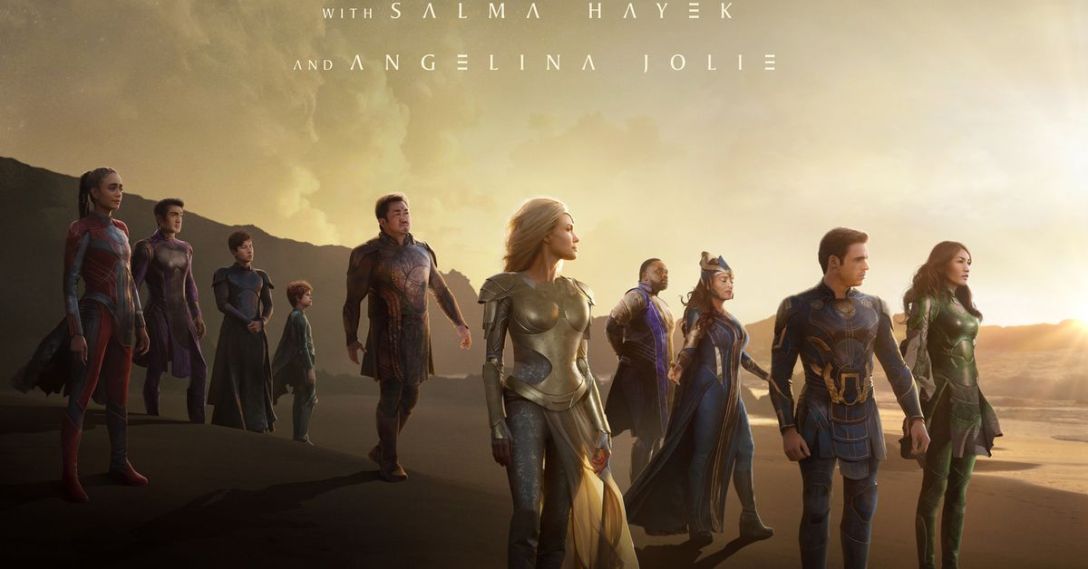
Eternals is a paradox, perhaps from the very beginning. For Marvel, it is meant to be a reset, or a glorious beginning, after the Avengers trilogy. Chloé Zhao was recruited to direct the film shortly after her Oscar win for Nomadland, a contemplative film without intergalactic war or computer-generated imagery. Eternals also unmistakably features an ensemble cast more diverse, more cosmopolitan than any other Marvel production. It is an ambitious, soul-searching production about the fate of humanity, free will and femininity. Its scope covers major events in human history while making scattered references to other Marvel films (duh). In short, Eternals feels like a mission impossible.
The result, however, has been mixed. Anticipation was high before the release. Marvel fans were curious about how Zhao’s anti-Marvel, humanist tone would add to the genre, a risk that Disney was apparently willing to take. Zhao also oddly confessed in an interview that she had always wanted to direct a Marvel film. The cast seems exciting, with Angelina Julie agreeing to star in a relatively minor role. Early reviews were expectedly polarised. Some welcomed the philosophical, theological undertone that other Marvel films ostensibly overlook; others find the screenplay too uneven to match its professed ambition. Some find Zhao’s distinct style a highlight in an otherwise stylistically monotone production series; others detested its oversimplification and self-importance. The film performed under expectation in the box office. Until this day, it is the worst reviewed film in the Marvel Cinematic Universe (MCU); it is the most un-Marvel film.
What went wrong? One explanation is how Marvel has evolved to be a particularly punishing genre. It has dictated how superhero films should be made; directors need to compromise their personal styles for the studio’s commercial instinct. After all, nobody watches Iron-Man for soul-searching or philosophical reflections, no matter how Marvel wants their audience to feel smarter than they truly are. Marvel as a genre is about pumping adrenaline and, to use a trendy term in 2021, metaverse building. It is a self-contained, self-sufficient genre with occasional acknowledgement of contemporary identify politics (which proves to be commercially successful, albeit culturally misappropriating, to use another popular term). In short, some argue that Marvel is stylistically conservative and intellectually naive.
Chloé Zhao, meanwhile, is one of the most un-Marvel filmmakers in the Hollywood at the moment. Born in a prominent household in Beijing but nevertheless censored in her homeland, Zhao rapidly rose to prominence thanks to Nomadland, a pandemic film streamlined by Frances McDormand’s dignified performance. Zhao’s organic, documentary style enchants Nomadland, as she zooms in the memory of an individual and reveals a universe of melancholy within an individual. Although Zhao is not a Nomad, the film’s sparse, minimalistic dialogues yield much space for imagination. The film is simple but not simplistic, timely but also timeless. It features an ineffable longing towards a less technologically advanced era that is as mythified as it is liberating, a purified era perhaps.
In many ways, Zhao’s Oscar victory reflects the industry’s dismissal of the Marvel-style filmmaking. Her involvement in the Eternals project is peculiar and self-defeating. Her humanist tone is not enough to confront the stylistic fence Marvel has built for itself over the years. I suspect that the fight scene before the opening credits were last added to the film so that Marvel has something for its trailer. After all, it covers the first five minutes of the entire film but almost all of the trailer. The inconsistencies and forced compromises seem preordained as the two sides collaborate.
There has also been another subtler criticism more targeted at Chloé Zhao for ruining Eternals. Even in Nomadland, Zhao’s ambiguous narrative structure and sparse dialogue do not always work out well. It seems that so many things are going on in a single story, like American dream, politics, history and culture in an increasingly globalised, unrooted world, but Zhao intentionally downplays them, reduces them and even dismisses them. None of the issues are given the weighty treatment they deserve, and the inexplicable combination intended for dramatic effects sometimes backfires. Some criticise the absurdity of Zhao’s script for its lack of practicality, like how Nomads get hospital treatments, pay taxes or bypass civic-institutional monitoring. Those things may be peripheral for the film’s central narrative but are crucial for the audience to keep their imagination grounded. People come and go in Nomadland, often too quickly to leave any signifiant mark.
In Eternals, Zhao’s distinct style encounters its most explicitly framed, documented criticism – she treats grand issues too easily. Although Zhao is known for her humanist tone, I cannot help but notice her scientific, carefully measured approach to filmmaking. She distributes roughly equal coverage to each historical period and character. Each of them comes and leaves like PowerPoint slides with a timer. She partitions her film into a grand history of human civilisation, but audience are lost in her mathematical attempt to create any dramatic effects. In some sense, Eternals is detached just like another Nomadland; Eternals are like the Nomads in a country where they belong and do not belong. The loose, oversimplified treatment of human history does not give human audience a sense of dignity as intended, but a baffling sense of self-importance. Audiences are confused about whether to take Eternals seriously as a philosophical thesis defending their free will, or leisurely as a superhero blockbuster bypassing reality check. Eternals does not seem to fit into either category.
To me, Eternals is an interesting film, really, because it gets things interestingly wrong rather than boringly right. It highlights the constraints or stylistical limits that I cannot notice if I am watching a Marvel production or a Chloé Zhao film in separate occasions. Zhao’s style dramatises the absurdity of Marvel productions. When Marvel productions are completely detached from human history or politics, they still seem more or less coherent (or no one truly cares). Audiences can still appreciate Spider-Man no matter whether Peter Parker shoots web from his vein or from a technological device. Audiences are equally amused. Marvel is meant for escapism. But not for Eternals, with its presumptuous acknowledgement of actual human history from the hunter-gatherer era, audiences are perplexed and offended. In Nomadland, Zhao’s humanist tone, minimalist documentary style received widespread acclaim when the audiences brought in their own social context, imaged themselves as the characters, and cooperatively supplemented narrative gaps for the film. But the same audiences are not Eternals who do not age. They find glaring inconsistencies in the fragmented storytelling intolerable.
It is unfortunate that Eternals have not been a critics’ favourite. To me, it is not the best film in the year, but it deserves a second watch. The elegant visuals and philosophical contemplations appeal to both serious and casual audiences. Perhaps the film exists out of a contradiction; it is pulling two ends of the spectrum. It seems to propose a grand narrative, or defend a cosmopolitan ideal, but audiences walk out of cinema feeling as if they have seen something, but maybe nothing at all.
 CARPE NOCTEM