The closing song on Lana Del Ray’s most recent album, Norman Fucking Rockwell, is titled Hope is a dangerous thing for a woman like me to have – but I have. At first glance, it seems too long a title, but in fact, not a single word can be taken out from it. In the minimalist production, Del Ray sings about being a modern American woman with (what she calls) a weak Constitution, reading a suicidal female poet, crying in a church basement and how her audience are perceiving her. It surveys a wide range of emotions and sensations beyond just melancholy and solitude that are featured in most of her old songs. At the end of her most recent and mature album, she concludes with a surprisingly weighty remark with much confession to make and much imagination to inspire. She is obviously holding this moment to the very last, as a summary of her album, her career and a way of looking forward. I cannot help but wonder what Del Ray is hopeful of, especially when her atmospheric songs seem to defy any hope and promote some indulgent moodiness.
To me, Del Ray started her career as an awkward singer on Saturday Night Live. During that much discussed broadcast, she almost missed every note and did not seem conscious about what she was doing. Her voice, although distinctive, was eclipsed by her rigid body movements and a long, white gown that did not particularly suit her. The performance felt at best uncomfortable, if not forced. She sang the track that made her a YouTube phenomenon, Video Games. It was a slow-burning song about troubled romance, insecurity and distrust. She also filmed the music video herself. The song defined her career while featuring that empty-minded, embellished voice. Despite the intimacy of her songwriting, her voice distanced her from what she was singing. She was singing about the pain that felt unbearable to her, but she managed to keep her composure and indifference in front of her audience. If anything, she never seemed to rush. There was something special about the way she chose to project her voice. There was something classical, or baroque, about her singing tone, but at the same time not quite. She did not want to reveal her artistry in full; she only offered a hint of what she felt, and what she could accomplish.
There’s a new revolution, a loud evolution that I saw / Born of confusion and quiet collusion of which mostly I’ve known / A modern day woman with a weak constitution, ’cause I’ve got / Monsters still under my bed that I could never fight off / A gatekeeper carelessly dropping the keys on my nights off
Hope is a dangerous thing for a woman like me to have – but I have
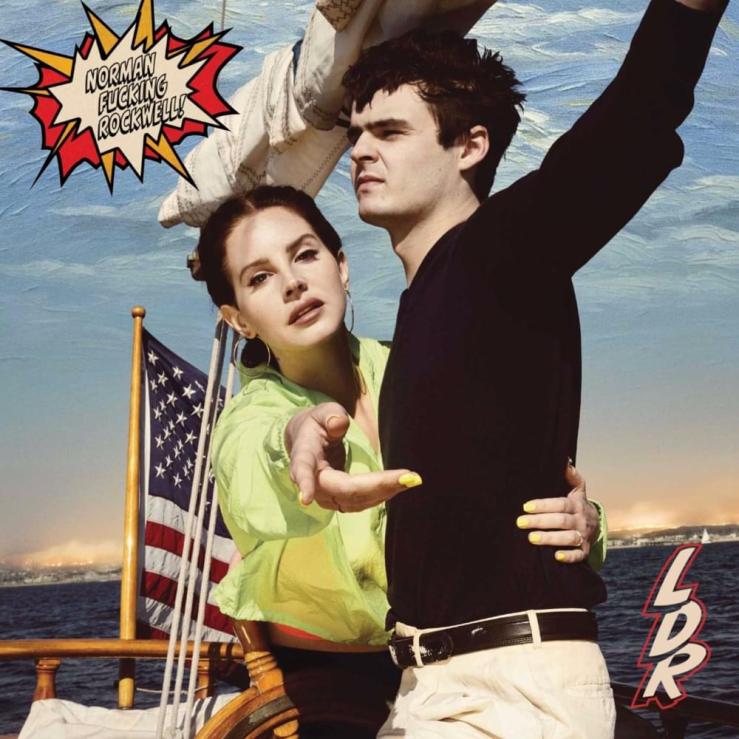
I was almost tricked by Video Games. I wrongly assumed that the song had all she wanted to say. To some artists, a much discussed failure on Saturday Night Live could effectively spell the end of one’s career. But that apparently does not apply to Del Ray. Over the years, she has sung for the pop audience, wrote several film soundtracks and produced some indie records. She appears in a branch of the record market that does not have much competition, or perhaps she single-handedly created that market. Her voice has divided her audience and critics. Some find her special, others dismiss her as the whining of a white, Manhattan girl. If she was still playing a melancholic girl longing for love in Born to Die, she has really matured in her latest Norman Fucking Rockwell. I was surprised to discover just how certain she has become about what she wants to say as an artist, and how weighty her art is and will be.
The album starts from a familiar place: “Godamn, man child”, she sings, “You fuck me so good that I almost said ‘I love you’ “. Del Ray briefs her audience with another tortured, misunderstood romance, another egoistic man who blamed the news for his bad poetry (love the witty line!) and never contemplated what he had put her through. The tone of the album opening is, surprisingly, a bit playful. It puts her in a somehow staged position to contemplate on a past romance. Following the album opener, she explores a range of feelings in a relationship. In Mariners Apartment Complex, she is the focus of attention, the protagonist who demands her sadness to be properly understood. In Fuck it, I love You, she longs towards one unreachable ideal in a romance. She feels so resolute, so determined to carry on. But she also wants to disappear, or to recollect a long-distance romance to come back to California. Del Ray is self-aware, and at times she feels incredibly painful for being so aware of herself physically, emotionally and geographically.
Del Ray is certainly not happy if she is only perceived as a white, Manhattan girl who only sings about her tortured romance. In her newest album, she travels to the West Coast. California is the metaphor of ideal love and the familiar American dream of glamour. She moans about the loss of culture, in the song titled The Greatest, right after she struggles with writing the next best American record. She confesses her confusion and pain; she no longer knows what it means to be an American woman. The entire album contains many references to an older era of America. She moans about the passing of time and what she calls the greatest loss of them all. She feels wasted, deprived and nostalgic. Is Norman Fucking Rockwell the next best American record? I do not know. But it certainly has the most temporal and geographical references to American culture in my recent memory.
It is heartening that Del Ray ends her newest album with Hope is a dangerous thing… After several failed relationships and moaning about a lost era, Del Ray finds her hope again in a confessional self-examination. She addresses some lasting mysteries about her. She does not claim to be happy, but at best she is not sad. She is, according to her lyrics, still hopeful as a modern American woman. The piano melody is so thin that I can hear her breath and hesitation. She talks about love, culture, technology, religion and politics. These are the things I sense all the time as a modern human being, but I often hesitate to write them down. I am afraid of connecting unrelated concepts in a forced narrative. But Del Ray just did what I found impossible, she did it effortlessly, and with grace.
Don’t ask if I’m happy, you know I’m not / But at best I can say I’m not sad / ‘Cause hope is a dangerous thing for a woman like me to have, but I have.
Hope is a dangerous thing for a woman like me to have – but I have
So what is Del Ray hopeful of, really? A revival of the American culture that she is longing? A romance that finally completes her? I have to say that I do not know because I’m not her. I am not an American woman. But I do feel her at the end of the album, almost too vividly. For a fleeting moment, I am not that different from her.
Fortunately, I am certain about my hope. Del Ray has been seeking hope and reconciliation in her relationship, her country and religion. She failed, repeatedly. And she had to write songs after songs. I have found hope in her song: quiet, nostalgic and confessional. I find reassurance in her art, and her sincerity, the things that I can finally count on.
 CARPE NOCTEM