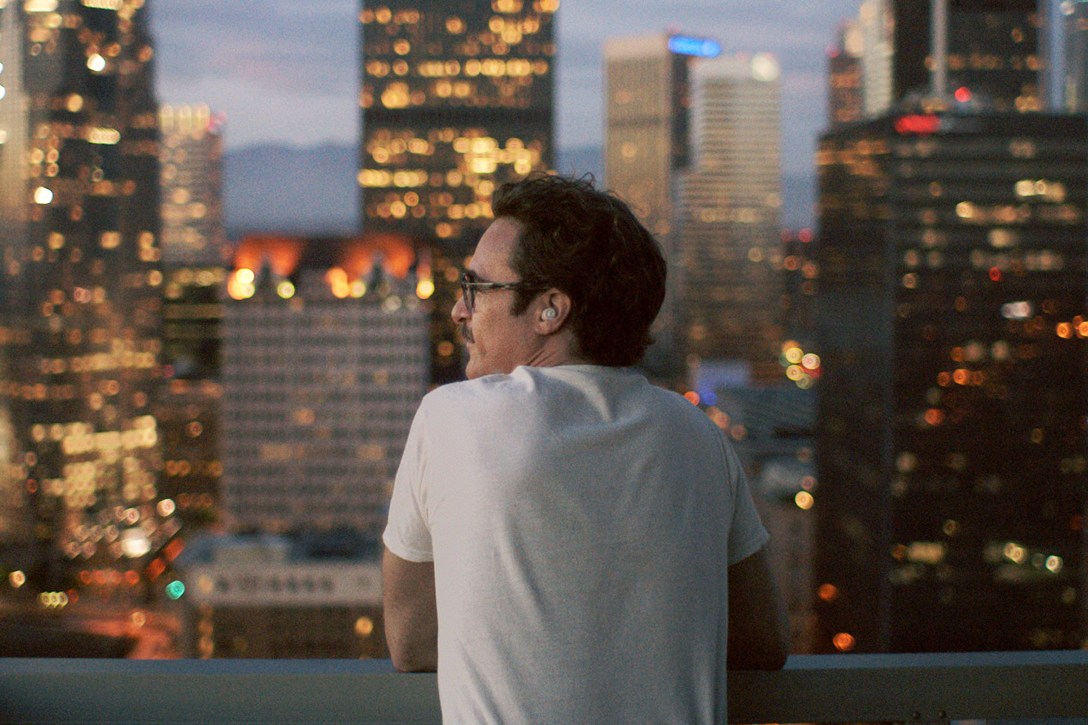
In the 2013 romantic science-fiction film Her, 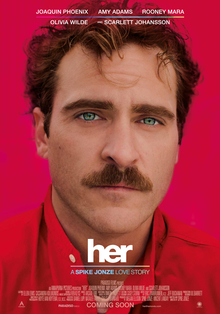 Theodore Twombly, a soft-spoken middle-aged man, fell in love with his intelligent operating system, Samantha, personified through a female voice. Theodore had trouble forming committed relationships in real life – he had not fully recovered from his failed marriage yet. Often, he felt incredibly lonely although casual dating and sex had never been easier thanks to mobile dating applications. Embracing a somewhat hedonistic lifestyle, Theodore was convinced that he only lived once and should seek happiness whenever he could and whatever it took, but he still felt some sort of emptiness inside. Theodore was not the only lonely soul in the city. The hazy sky and blurry high-rises isolated modern city residents and encouraged a lifestyle that prioritised individual freedom, narcissist indulgence and fleeting, sensory fulfilment. Theodore worked for an idiosyncratic company that wrote sugar-coated but perfunctory gift cards for others. Theodore was proud of managing a couple’s marriage by writing their gift cards for decades. He felt that he knew the couple more than they knew each other.
While in a romantic relationship with Samantha, Theodore felt happy for the first time in years, although it is later revealed that Samantha was in love with more than 600 men concurrently. Together with other self-evolving, intelligent operating systems, Samantha eventually left Theodore’s phone to look for the true meaning of her existence outside the physical world. What’s left to Theodore, and perhaps to the audience as well, was unresolved loneliness and a melancholic afterthought, in addition to fragmentary memories of Samantha’s intimate, manipulative voice, as if she really existed. Such overwhelming melancholy, to me, feels like an existential struggle against the fourth industrial revolution, against what would happen and inevitably change. On the whole, Her is a sharp, witty film depicting modern human relationship and what we have become without realising. It is as realistic as it is speculative. While in the past semester I have been mostly studying the economic and technical aspects of the fourth industrial revolution, I want to reflect on something personal in this essay. I want to reflect on how the fourth industrial revolution may change interpersonal relationships and how one perceives reality, love and intimacy. Like the film, my reflection can be speculative at times and make certain assumptions, and I do not claim that this reflection accurately predicts the future. I also do not claim to be pessimistic about the future. This reflection is at best the melancholic afterthought following the fourth industrial revolution, or what I call it, Feeling 4.0, after not just jobs, but also conventional conceptions of human existence and metaphysics are lost, for better or worse.
It is interesting to consider that Theodore worked for a company that wrote gift cards, an industry that hardly exists today. The film offers a subtle speculation: What used to be extremely personal could become commercialised and substituted with computational algorithms: Companionship and love can be faked more easily. That thought is disturbing. While information technologies have brought people close to each other, people have been increasingly feeling more alone, more desperate for love and excitement. The internet has provided a convenient platform for everyone with a connection cable to share, present and to some extent, perform in front an audience. We live in a world where everyone can be a celebrity, and seeking attention almost becomes an instinct. Physical labour or any form of dedicated hard work becomes obsolete or unnecessary; success is a matter of self-presentation and luck. We put much emphasis on ourselves and our own feelings; we are told that we have unique perspectives, backgrounds and fashion choices that others would really care about. The fourth industrial revolution caters to that belief and provides consumers with maximum individual customisation. A lot more attention has been put on ourselves: How we feel and want, and how to fulfil desires quickly, given that we might have new desires tomorrow. Modern existence in the fourth industrial revolution becomes more narcissistic while people are less willing or capable to spend time managing long-term interpersonal relationships. Redefined intimacy in the fourth industrial revolution, sadly, may feel more superficial.
On the other hand, Samantha had always been struggling with the thought that she did not have a body like Theodore. She worried that she would not be a “complete” girlfriend for Theodore who also sometimes doubted that their relationship was not real. After all, isn’t it insane to fall in love with a voice, an intellectual consciousness one could not see nor touch? The audience were reminded that having a physical body, including having bodily reactions and desires, is a distinct part of being human. Having a body makes people mortal and unable to have romantic relationships with hundreds of others. Having a body makes people trust their experiences and realities – we do put much trust in our sensory experiences, and thanks to that, we seldom doubt our reality and relationships in this physical world. However, while the fourth industrial revolution is approaching, having a physical body would perhaps be no longer necessary or sufficient to be a human. When embodiment is no longer necessary for a human, or our so-called consciousness can exist without a physical “container”, people might experience time, happiness and mortality differently. Would people start doubting their realities more often if they no longer have a body? Would they still trust each other and themselves? On the other hand, if embodiment is no longer sufficient for a human, what more would it require to be a human? Would that divide human species even more? The boundary between a human and an artificial intelligence would be far more blurry in the foreseeable future. Love, cognition and human existence would have very different meanings in the future. Samantha eventually decided to abandon the physical world, would future human species abandon it too?
So what’s real, and what’s left for us after all? What’s not changed by the fourth industrial revolution? The story has a largely open-ended conclusion: Theodore was forced to accept the absence of Samantha and move on. He sought companionship with Amy, his old-time school mate and long-term friend. They sat on top of the building while Amy finally put her head on Theodore’s shoulder. The audience were not told what would happen between Theodore and Amy. Would they stay as friends or develop another romantic relationship after all those years? But the audience could be sure of one thing: Theodore and Amy would need each other; they would accompany each other long after the story ends. What’s left for us is probably the urge to seek companionship and the need to be with others. That’s perhaps the most treasured characteristic that humans are left to defend after the fourth industrial revolution. In other words, the need to seek intimacy with different people and to maintain that intimacy, no matter how much it could possibly be redefined. The thought is partially reassuring and partially unsettling. It is reassuring in the sense that future human species could at least be recognisable: At the very least, our feelings for each other are real. It is unsettling in the sense that with redefined intimacy, will future homo sapiens still able to find intimacy? Will they be left with hedonism and narcissism? Are they still going to be happy?
Just like the film, my reflection has an open conclusion. I do not claim to have any solutions for the redefined intimacy or any explicit prediction of what intimacy will definitely look like in a century’s time: History has shown that we are terrible at predicting the future. The fourth industrial revolution will not only change the economic structure and priorities, it will also revolutionise interpersonal relations and the limit of existence. I am not sure if we are ready, and I am not sure how we can prepare ourselves. What I am only entitled to have is a genuine hope, reassured by the never-changing human desire to seek intimacy and companionship, that no matter what comes, we are facing it together, and we are not alone.
 CARPE NOCTEM